
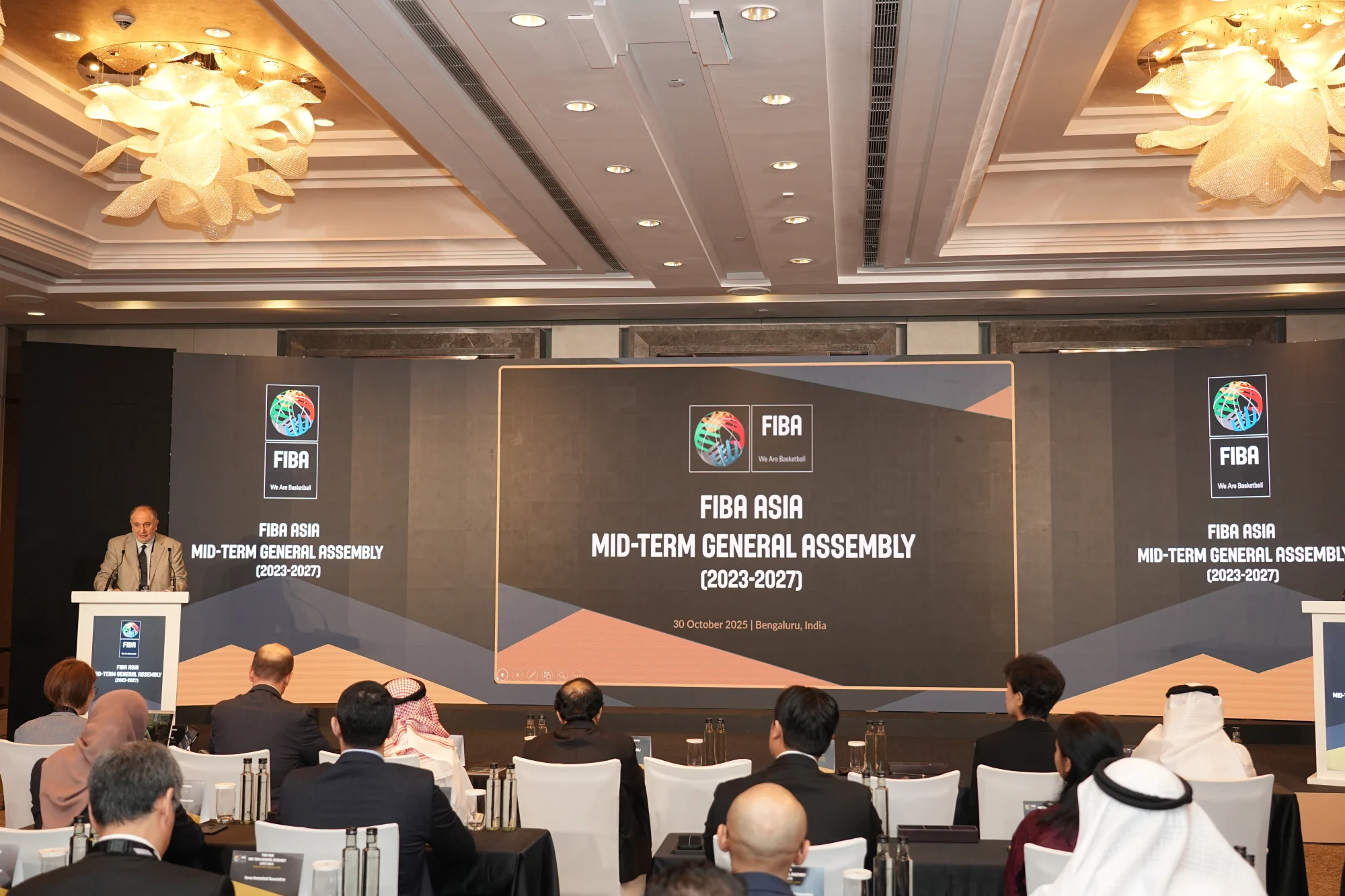
The FIBA Regional Office-Asia successfully held its Mid-Term General Assembly for the 2023–2027 cycle in Bengaluru, India, on October 30, 2025. Representing the Basketball Federation of Bhutan (BFB) at this critical continental gathering was Assistant Program Officer Sonam Choden. The high-level assembly brought together top international basketball administrators, including FIBA President Sheikh Saud Ali Al Thani, to review the progress of the past two years and chart a strategic roadmap for the remainder of the cycle.
Global Strategies and Governance Revisions
The central themes of the assembly focused heavily on elevating the caliber of Asian competitions, fostering grassroots development, and strengthening National Federations (NFs) through targeted frameworks like the FIBA Plus program. To address regional disparities and operational bottlenecks, FIBA Asia Executive Director Mr. Hagop Hagopian announced the formation of a specialized Task Force. This unit, comprised of managers from various departments within the Regional Office-Asia, is designed to coordinate direct interventions and help specific sub-zones overcome localized challenges.
In addition to elite-level strategies, the assembly spotlighted impactful grassroots and inclusivity campaigns, notably the “Basketball for Good” initiative and the women’s basketball program, “Her World Her Rules.” Important administrative clarifications were also made regarding federation governance. The assembly confirmed that a National Federation’s constitution must primarily align with its respective national laws. Rather than focusing solely on copying the template of the global FIBA constitution, federations were advised that this alignment process should be managed by a dedicated, local legal commission or team.
3×3 Basketball: The Accelerated Path for Bhutan
A major takeaway for developing basketball nations was the strong recommendation from continental experts to focus strategic efforts heavily on the 3×3 basketball format. Because 3×3 requires fewer players, a smaller footprint, and lower infrastructure overhead than traditional 5v5 basketball, it is viewed by FIBA Asia as the most effective and accelerated pathway for countries like Bhutan to develop elite programs and achieve rapid popularity on the international stage.